The Left Fifth Toe: Self-Trust & Inner Safety
TL; DR: The left fifth toe reflects your relationship with self-trust, inner safety, and vulnerability.
What the Left Fifth Toe Represents
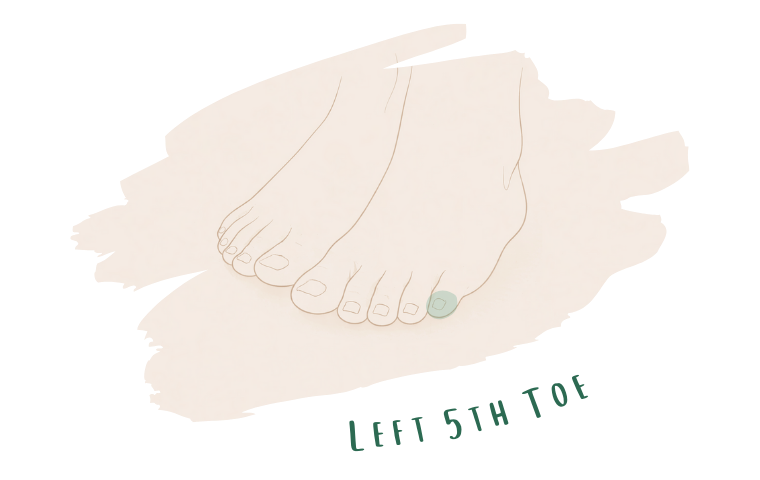
In toe reading, the left fifth toe is associated with self-trust — how safe it feels to rely on yourself from the inside.
This toe represents:
-
your sense of inner safety and stability
-
how you respond when trust is tested
-
your relationship with vulnerability and protection
-
whether self-trust feels steady, fragile, or guarded
The fifth toes are slow-growing and slow to heal, and they’re often the toes people injure or break. This makes them powerful indicators of how the body responds when trust, safety, or support feels compromised.
Where the right fifth toe reflects trust in the outer world and with others, the left fifth toe reflects trust in yourself.
Why This Toe Is Helpful to Notice
Observing the left fifth toe can bring awareness to how you experience self-trust over time.
It may highlight:
-
if you second-guess yourself
-
patterns of bracing, protecting, or holding back
-
how you respond to uncertainty or risk
-
places where trust has been shaken — or slowly rebuilt
If you’ve ever injured or broken this toe, it can be meaningful to reflect on what was happening in your life at that time, especially around safety, support, or self-reliance.
Noticing this toe isn’t about blame. It’s about listening.
How to Gently Observe the Left Fifth Toe
fuPeople often begin wondering about the spiritual meaning of the left fifth toe after something draws their attention — a stubbed toe, repeated injury, tenderness, or simply noticing how small or tucked away it feels. Gently observing the toe can offer insight into how the body reflects trust and vulnerability.
So, take off your socks and spend a moment with your left fifth toe. Rather than analyzing or trying to interpret right away, begin by noticing its position, shape, and direction.
Position & Direction
-
Pointing toward the midline → attention oriented toward past experiences where trust may have been challenged.
-
Pointing away from the midline → orientation toward future possibilities; a willingness (or desire) to trust again.
-
Pointing straight ahead → a steady, present-moment relationship with self-trust.
Shape & Visibility
-
Visible and relaxed → comfort with vulnerability and inner safety.
-
Tucked, curled, or withdrawn → protection, guarding, or hesitation around trust.
-
Sensitive, bruised, or injured → areas where trust may feel tender or easily impacted.
Pause here and observe what feels familiar. No judgement. Only awareness.
A One-Minute Check-In With Your Left Fifth Toe
-
Sit or stand comfortably and look at your left fifth toe without adjusting it.
-
Describe what you see using neutral words.
-
Gently massage or observe your toe and ask yourself:
-
What is my relationship with self-trust right now?
If I’ve ever injured or broken this toe, what was happening in my life at that time?
-
Take one slow breath and acknowledge what you noticed.
Looking for more?

Download our free guide, In-TOE-Ition: A Beginner's Guide to Toe Reading, to explore the other toes and continue learning with the Toe Reading Academy.
TOE-RIFFIC! YOUR GUIDE IS ON IT'S WAY!
Check your inbox for an email from Toe Reading Academy.
You will also be added to our mailing list. We send occasional emails with toe talk and tips. No spam ever! You can unsubscribe at any time.
A Gentle Reminder
Toe reading is a reflective, body-based practice, not a diagnostic tool. The toes offer information — not instruction. Awareness supports choice, not pressure.
______________
(c) Toe Reading Academy
Christina Jenkins & Marisa Raymond
Updated: January 11, 2026