How Toe Reading Made Me a Better Yoga Teacher
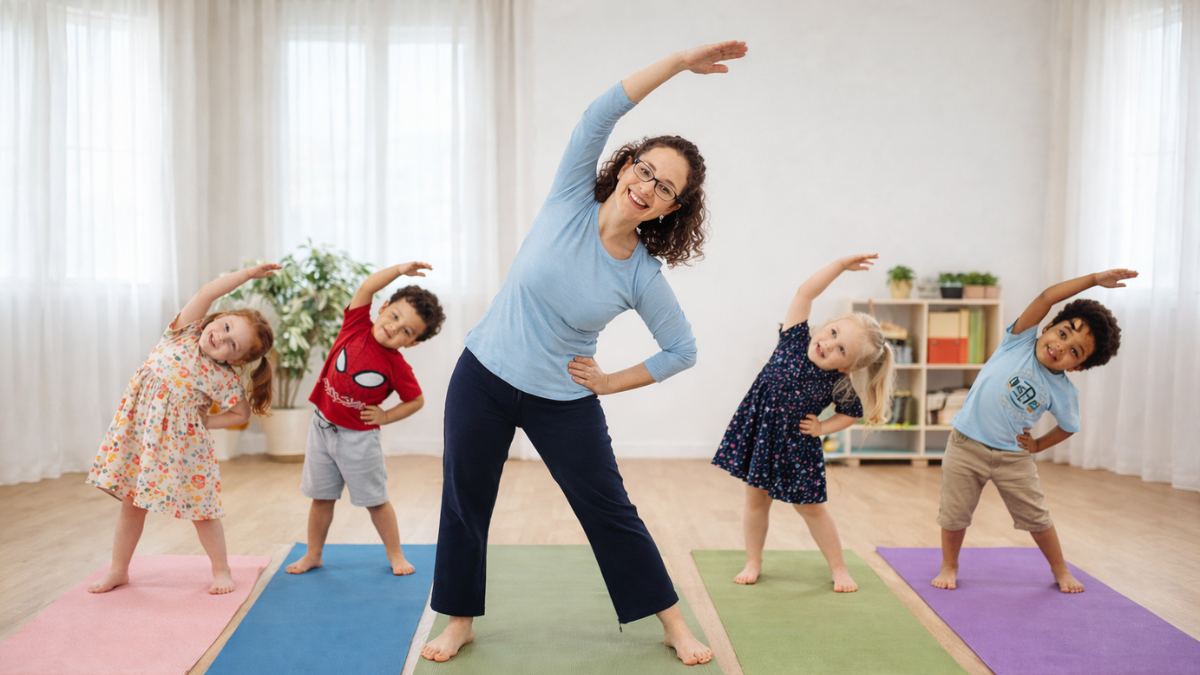
This post is Part 1 in an ongoing series where Christina and Marisa share how they weave toe reading into their other areas of practice and expertise. Today, Marisa shares what happens when she brings toe reading into her yoga classroom.
There's a particular kind of chaos that can take over a room full of preschoolers.
If you've ever been in one, you know exactly what I mean.
Children at that age are sponges — not just for learning, but for energy. One child's excitement becomes another's distraction becomes another's full-body response, and before you know it, what started as a drizzle has become a full-blown tropical storm.
In addition to being a founding members and facilitator at Toe Reading Academy, I teach yoga in English, in French schools, in Bordeaux. Which means that on top of everything else, there's a split-second language switch every time I need to redirect a child — and in a room of preschoolers, that split second is enough for everything to unravel.
I needed another way to read the room.
I found it in my students' toes.
The mat is already the perfect place
Here's something that seems obvious once you hear it: in almost every professional setting, feet are hidden. Shoes, socks, boots — the body's most expressive map tucked away before the day even begins.
Yoga is different.
The moment a student steps onto the mat, they're barefoot. No asking, no awkwardness — toes are simply there, open and available. That means every session begins with something most practitioners never get: a quiet, non-intrusive glimpse into who my students are and what they might be carrying that day.
I arrive with a lesson plan. And then I let what I see guide me.
The boy who had a lot to say
One child in particular stays with me.
He was four years old, in a class of about ten students at a private school. He was the kind of kid who could easily be labeled "hyperactive" or a "problem child" — the kind who couldn't stop talking, couldn't stop moving, couldn't stop telling the child next to him exactly what to do and how to do it.
But I looked at his toes, and I saw something different.
His second toes were noticeably longer than the others — the toe of communication and expression. And his third toe, the toe of action, was pressed close alongside it, nearly overlapping. When I see that presentation, I know: this is someone whose words and actions want to be in alignment. It's how he's wired.
And at four years old, he hadn't yet learned how to do that without pulling everyone else into his orbit.
Rather than scolding him or separating him from his friend, I lowered my voice and said something that acknowledged what I saw in his toes:
"I know you have a lot to say. And I know you really want this other child to do it the right way. But I've noticed — you're spending so much time telling him what to do that you're not actually doing the thing yourself. So let's take a deep breath like a race car and shake our bodies. You'll be able to talk to him when we're done."
I changed the activity. I created space for the whole class to move, to express, to channel that energy elsewhere.
And something shifted.
What proactive permission looks like in practice
I call it proactive permission — and it's become one of the cornerstones of how I teach.
Rather than waiting for a child to act out and then responding, I use the toes to understand a bit about each child before anything needs to be corrected. I can see right away who has a long second toe — the natural communicators, the ones who light up when given space to share. And I can recognize the children who are quieter, who need a gentler invitation rather than a push.
That's what toe reading made possible: not a diagnosis, not a label, but a moment of genuine recognition.
I see you.
I understand what you need.
Let's work with that.
And when children feel genuinely seen — when an adult meets them exactly where they are instead of asking them to be something else — something opens.
What this means for you
My students are preschoolers. But the principle holds whether you're teaching an adult yoga class, facilitating a reiki healing, leading a coaching session, working with clients on a massage table, or parenting your own children at home.
The body is always communicating. The toes are always telling a story. The more fluent we become in that language, the more deeply we can serve the people in our care.
Want to hear more of this conversation? You can watch the full Toe Talk Tuesday episode on YouTube — and stay tuned for Part 2 of this series, where Christina shares how toe reading shows up in her own practice.
Ready to bring this kind of attunement into your own work?
We'd love to help you get started. Download our free In-TOE-ition Beginner's Guide and take your first step toward reading the stories your clients are already showing you. Or if you're ready to go deeper, explore our Level 1 Certification — the Toe-by-Toe Journey.
Because every toe really does tell a tale. 🦶